Posts

Showing posts with the label Kings

King Ramses IX - Royal Mummies

Image
King Ramses IX King Ramses IX - Royal Mummies The eighth king of the 20th Dynasty, New Kingdom, Ramses IX was the grandson of Ramses III . His principal contributions were to the Sun Temple in Heliopolis; he also decorated the north wall of the Seventh Pylon of the complex of Amun-Re at Karnak . The original burial place of Ramses IX, a beautifully painted tomb that still retains its colors today, was KV 6; his mummy was moved several times before it was hidden in the Deir el-Bahari cache, where it was discovered in 1881. His mummy will be transferred from the Egyptian Museum in Tahrir to the National Museum of Egyptian Civilization on April 3.

King Ramses VI - Royal Mummies

Image
King Ramses VI King Ramses VI - Royal Mummies Ramses VI is one of the sons of Ramses III . He ruled for about eight years.  His mummy was discovered in 1898 in the Tomb of Amenhotep II (KV 35) in the Valley of the Kings, Luxor.  This mummy will be transferred in The Pharaoh's Golden Parade on April 3 from the Egyptian Museum in Tahrir to the National Museum of Egyptian Civilization in Fustat

King Ramses V - Royal Mummies

Image
King Ramses V King Ramses V - Royal Mummies King Ramses V opened the sandstone quarries at Gebel Silsila and sent expeditions to the mines in the Sinai for copper and turquoise.  He was the son of Ramses IV, New Kingdom, Dynasty 20.   His mummy was discovered in 1898 in the Tomb of Amenhotep II (KV 35) in the Valley of the Kings, Luxor.  Stay tuned for the parade of the royal mummies from the Egyptian Museum in Tahrir to the National Museum of the Egyptian Civilization on April 3.

King Ramses IV - Royal Mummies

Image
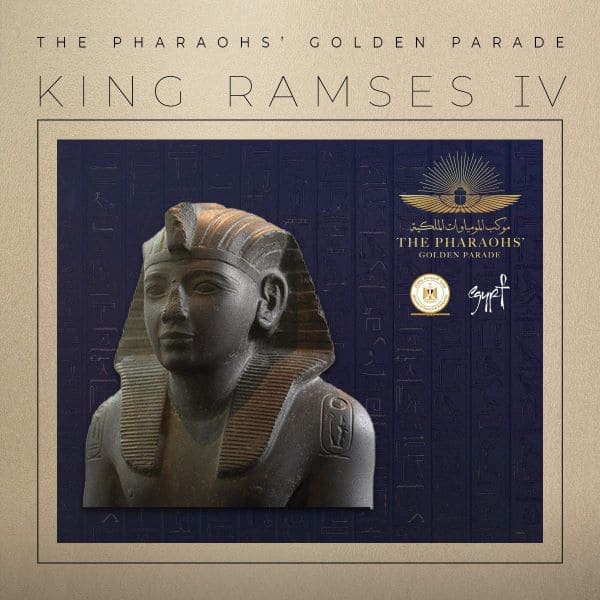
King Ramses IV King Ramses IV - Royal Mummies Although his father was murdered by conspirators trying to take over the throne for the son of a minor queen, the legitimate crown prince, Ramses IV, succeeded in keeping the crown. During his short reign, he did a lot to honor his father’s memory and continue his policies. His mummy was discovered in 1898 in the Tomb of Amenhotep II (KV 35) in Valley of the Kings, Luxor. His royal mummy is among the 22 mummies being transferred from the Egyptian Museum in Tahrir to the National Museum of the Egyptian Civilization in The Pharaohs’ Golden Parade.

King Ramses III - Royal Mummies

Image
King Ramses III King Ramses III - Royal Mummies ‏Considered the last of the great "warrior pharaohs" of the New Kingdom, Ramses III fought many notable battles and is remembered as skilled in the art of warfare. Despite his great victories and accomplishments, he fell victim to a plot devised by a minor wife, Tiye , to put her son Pentawer on the throne. Several papyri tell of this "harem conspiracy" to kill the king, which involved various officers, members of the royal harem, and high court officials. CT scans carried out by the Egyptian Mummy Project showed clearly that the king’s throat had been cut from behind. Perhaps to make sure that the king would be healed and complete in the afterlife, an eye of Horus amulet was placed on the right lower rim of the wound.  The Mummy of the king was discovered in the Deir el-Bahari Cache (TT 320), west of Luxor in 1881, and will be transferred with 22 royal mummies in The Pharaohs’ Golden parade from the Egyptian Museum ...

King Siptah - Royal Mummies

Image
King Siptah King Siptah - Royal Mummies Siptah came to the throne as a boy, placed there by a powerful official named Bay. Since he was too young to rule alone, his stepmother Tawosret, wife of Seti II , took on the role of regent. His mummy was discovered in 1898 in the Tomb of Amenhotep II (KV 35) in Valley of the Kings, Luxor. It will be transferred with the royal mummies in The Pharaohs’ Golden parade from the Egyptian Museum in Tahrir to the National Museum of the Egyptian Civilization.  Don’t miss this incredible event!

King Seti II - Royal Mummies

Image
King Seti II King Seti II - Royal Mummies The mummy of King Seti II, the fifth pharaoh of Dynasty 19, was discovered in 1898 in the Tomb of Amenhotep II (KV 35) in Valley of the Kings, Luxor. The mummy was found enshrouded in many layers of exceptionally fine linen. For the most part, Seti II’s facial features are well-preserved. His mummy will be transferred on April 3, from the Egyptian Museum in Tahrir in the Pharaohs’ Golden Parade to the National Museum of the Egyptian Civilization.

King Merenptah - Royal Mummies

Image
King Merenptah King Merenptah - Royal Mummies King Merenptah was the son of the Great Ramses II , New Kingdom, Dynasty 19. Due to his father’s very long reign, he ascended the throne at an advanced age. He engaged in many military campaigns. His mummy was discovered in 1898 in the Tomb of Amenhotep II (KV 35) in the Valley of the Kings, Luxor. The 22 royal mummies transferred from the Egyptian Museum in Tahrir to the National Museum for Egyptian Civilization, in an unprecedented event on April 3, 2021.

King Ramses II - Royal Mummies

Image
King Ramses II King Ramses II - Royal Mummies He signed the first known peace treaty in history with the Hittites and was remembered as a great warrior, King Ramses II is arguably the most famous of the New Kingdom pharaohs. He recorded his Battle of Kadesh, which he fought against the Hittites, in multiple places. This pharaoh built temples almost everywhere in Egypt. The most famous of which is Abu Simbel and the Ramesseum (dedicated to his mortuary cult). His Great Royal Wife was Nefertari , for whom he built a temple near his own in Abu Simbel. Ramses II succeeded his father Seti I and enjoyed a long reign. Ruling for 67 years, he left a well-recorded legacy. His mummy was discovered in the Deir el-Bahari Cache (TT 320), west of Luxor in 1881. Prepare yourself to watch the journey of his mummy among 22 royal mummies from the Egyptian Museum in Tahrir to the National Museum of Egyptian Civilization in The Pharaoh’s Golden Parade on April 3.

King Seti I - Royal Mummies

Image
King Seti King Seti - Royal Mummies One of the most beautiful and best-preserved of the royal sepulchers is the tomb of Seti I in the Valley of the Kings , with wall decorations in vivid colors. Son of Ramses I, the founder of Dynasty 19, New Kingdom, Seti I lead a battle against the Hittites. His military activities and victories were carefully recorded at Karnak, in the temple of Amun. His mummy was discovered in 1898 in the Tomb of Amenhotep II (KV 35) in Deir El Bahari. It is one of the mummies being transferred in the unrivaled Pharaohs’ Golden Parade on April 3 from the Egyptian Museum in Tahrir to the National Museum of Egyptian Civilization in Fustat.

King Amenhotep III - Royal Mummies

Image
King Amenhotep III King Amenhotep III - Royal Mummies A colossi statue of King Amenhotep III and his wife Queen Tiye, a symbol of their strong bond and eternal power, is an iconic sight at the Egyptian Museum in Tahrir.  His memorial temple at Kom el-Heitan was fronted by huge statues now known as the Colossi of Memnon, Amenhotep III left behind many major monuments, including a large number of statues.  King Amenhotep III is the son of Thutmose IV , New Kingdom, Dynasty 18 His mummy was discovered in 1898 in the Tomb of Amenhotep II (KV 35) in the Valley of the Kings , Luxor.  Don’t miss the journey of King Amenhotep III amongst 22 royal mummies in the Pharaoh’s Golden Parade as they move from the Egyptian Museum in Tahrir to the National Museum of Egyptian Civilization on April 3, 2021.

King Thutmose IV - Royal Mummies

Image
King Thutmose IV King Thutmose IV - Royal Mummies Thutmose IV was the King who erected "The Dream Stela" between the paws of the Great Sphinx at Giza. "The Dream Stela", tells us the story of how, as a young prince, he fell asleep in the shade of this colossal figure while hunting in the desert nearby. The Sphinx appeared to him in his dreams and instructed him to clear away the sand that covered its body; in return, he would be made the next pharao and he was Discovered in 1898, in the tomb of Amenhotep II (KV 35) Cache in the Valley of the Kings , Luxor. The mummy of Thutmose IV will be among the 22 royal mummies transferred in a grand parade, The Pharaohs’ Golden Parade,  from the Egyptian Museum in Tahrir to the National Museum of Egyptian Civilization. 

King Thutmose III - Royal Mummies

Image
King Thutmose III King Thutmose III Too young to rule after the death of his father, Thutmose III began his reign as monarch in name only. His stepmother, Hatshepsut , served as his regent for several years, and then declared herself pharaoh. For the next two decades, the young monarch grew into what would become his eventual role as one of the warrior pharaohs of the New Kingdom. After her death, he launched a series of military campaigns that solidified Egypt’s position as one of the region’s superpowers. His battle at Megiddo is considered a model of military strategy. Discovered in the Deir el-Bahari Cache (TT 320), west of Luxor in 1881, the Mummy of the king will be transferred with the royal mummies in The Pharaohs’ Golden Parade from the Egyptian Museum in Tahrir to the National Museum of the Egyptian Civilization on April 3

King Amenhotep II - Royal Mummies

Image
King Amenhotep II King Amenhotep II King Amenhotep II was remembered as a great sportsman. The tallest of his bloodline, this king boasted of his athletic prowess, often representing himself performing feats of strength and skill. He had a reputation as an excellent charioteer and displayed considerable skill with the bow and arrow. King Amenhotep II is the son of King Thutmose III of the Dynasty 18, New Kingdom. He fought campaigns securing wealth and power for Egypt.  His mummy was discovered in 1898 in his tomb (KV 35), the Valley of the Kings, Luxor, and it is one of the 22 royal mummies being transferred from the Egyptian Museum in Tahrir to the National Museum of Egyptian Civilization. Watch the Pharaoh’s Golden Parade live on April 3, 2021

King Thutmose II - Royal Mummies

Image
King Thutmose II King Thutmose II King Thutmose II is the son of King Thutmose I , Dynasty 18, New Kingdom. His reign was secured through his marriage to his half-sister, Hatshepsut, daughter of Thutmose I’s. His son, Thutmose III, succeeded him on the throne. His mummy was discovered in Al-Deir El-Bahari Cache (TT 320) west of Luxor in 1881. Studies show that the king died at approximately the age of 30. This royal mummy will be transported in a magnificent parade, The Pharaohs’ Golden Parade, on April 3 from the Egyptian Museum in Tahrir to the National Museum of Egyptian Civilization in Fustat.

King Thutmose I - Royal Mummies

Image
King Thutmose I King Thutmose I One of the 22 royal mummies being transferred from the Egyptian Museum in Tahrir to the National Museum of Egyptian Civilization is that of King Thutmose I, Dynasty 18, New Kingdom. Thutmose I became king after Amenhotep I died without an heir. He came to the throne around the age of 40. His accomplishments included substantial campaigns and the expansion of Egyptian rule in the south. His military campaigns opened new opportunities for trade, diplomacy, and economic exploitation with Egypt’s neighbors. King Thutmose, I was the father of Queen Hatshepsut.  His mummy was discovered in the Deir el-Bahari Cache (TT 320), west of Luxor in 1881. Stay tuned for the Pharaohs’ Golden Parade on April 3

King Amenhotep I - Royal Mummies

Image
King Amenhotep I King Amenhotep I - Royal Mummies The second pharaoh of  Dynasty 18, Amenhotep I was a child when he became king and ruled with the assistance of his mother, Queen Ahmose-Nefertari . Amenhotep I led several military campaigns. He also began or completed many construction projects. Remembered as a great ruler, he was deified after his death alongside his mother. The mummy of King Amenhotep I was discovered in the Deir el-Bahari Cache (TT 320), west of Luxor in 1881. It will be among 22 royal mummies transferred in a grand parade from the Egyptian Museum in Tahrir to the National Museum of Egyptian Civilization . Wait for the Pharaoh’s Golden Parade on April 3, 2021

King Seqenenre Taa - Royal Mummies

Image
King Seqenenre Taa King Seqenenre Taa - Royal Mummies Today, we present King Seqenenre Taa, whose mummy is one of the 22 royal mummies who will be transferred in the Golden Pharaoh’s Parade from the Egyptian Museum in Tahrir to the National Museum of Egyptian Civilization . King Seqenenre Taa was the ruler of Thebes (modern-day Luxor).  History remembers Seqenenre Taa as the king who began the liberation war against the Hyksos, a war which continued by his sons Kamose and Ahmose I The mummy of Seqenenre Taa’s was discovered in the Cache of Deir El-Bahari (TT320), west of Luxor in 1881.  Wait for the Golden Pharaoh’s Parade on April 3.